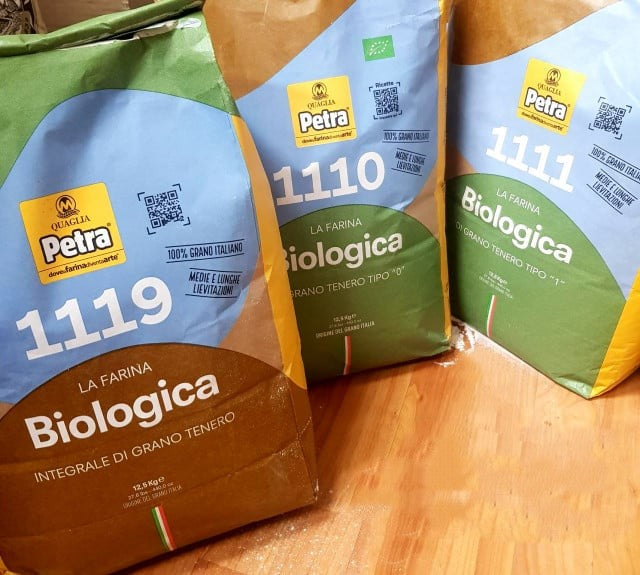
Type "0" soft wheat flour with rice flour, ideal for Pinsa Romana. Packs of 3, 6, and 12.5 kg.
Free from additives, Petra 5010 creates highly hydrated doughs ideal for medium and long leavening, thanks only to the protein quality of specially selected wheat. Doughs made with Petra 5010 are stable and easy to work with. The finished product is characterized by a remarkable lightness and unique crumbly quality. Rice flour ensures maximum melt-in-the-mouth quality. Suitable for: pinsa Romana, pan pizza, focaccia with medium and long leavening times (8 hours at room temperature of 22-25°C, up to 48 hours in a refrigerated condition at 4°C). It can be used with direct and indirect doughs, and with live sourdough starter. NB: The 1 and 5 kg packs are portioned from larger bags.
WHAT IS PINSA: Pinsa is a particular type of pizza that requires high hydration (80-85%) and its main characteristics are lightness, digestibility, and the fragrance of the dough, all strictly GMO-free. This care and optimization of the dough have given life to a product loved by the public. The term Pinsa (from the Latin pinsere: to stretch, to lengthen) comes from history, more precisely from the ancient Romans who used to prepare an elongated focaccia. This shape is still used today: the pinsa is in fact oval in shape. The exclusive invention (registered trademark) is the work of a food production company in Rome that has been in the sector for years and has extensive experience in the field of flours for all types of pizza. To produce Pinsa Romana, a single type of flour can be used, composed of a mix of: wheat flour; • soy flour; • rice flour; • dried sourdough starter (mother yeast). This mix is produced by the company described above and has been studied and optimized over the years. The percentages of these three flours in the mix are not specified (industrial secret). The kneading phase is dictated by a protocol that must be followed to the letter to produce the product correctly.
DOUGH AND PROCESSING: Now let's move on to making the dough. Proper maturation for Pinsa Romana is essential: by following the process correctly, you can exploit the true potential of this product. Dough quantities: Ingredients: Weight: Flour 1.3-1.35 kg Water 1 l Yeast 2-6 g Salt 20-25 g Oil 20 g
The dough is left to rise in the refrigerator using the cold process: the product can be used for 24 to 120-150 hours of leavening; it reaches its best state (complete maturation) after 48 hours. The time interval to make the most of this dough is between 48 and 96 hours of leavening. To make a dough of this type (up to 120 hours or more), two fundamental elements are needed: flour, which must be suitable for this type of leavening due to its high gluten content, and the technique, which allows the dough to be worked within these times.
Here are some important tips for the kneading phase:• Check the temperature at the start of kneading: water and flour mixed
must have a temperature of 7-13°C max (start from cold/low
temperatures)• Add salt at a dough temperature of 21°C• Finish kneading at 23-24°C max. As already studied in previous chapters, by keeping the dough temperature low, the yeast acts more slowly, thus increasing the leavening times;
As a result, maturation will be able to occur correctly. All this will produce a high and pleasant degree of digestibility and fragrance.
of the pasta.
COOKING: Pinsa Romana is best cooked in electric ovens: there's even a company that produces specialized ovens for this product. In terms of hydration and cooking method, pinsa is very similar to pizza in pala. The oven setting should therefore be approximately 320°C with a 75% top and 25% bottom. I always remind you that these data are standard: each dough and each oven requires "personal" adjustments during cooking. Furthermore, don't forget that baking a large number of pizzas reduces the power of the top and bottom elements, and to maintain the temperature, it will be necessary to increase the power of these two elements. One cooking method used for Pinsa Romana is pre-cooking.
PRE-COOKING: In all preparations, when the term pre-cooking or pre-cooked food is used, a low level of quality is always expected. In the case of pinsa, this is not the case: the technique of pre-cooking the dough offers quality and ease of processing. Pre-cooking consists of cooking the already rolled out pinsa for about 40 seconds: during this time the dough will set, or rather crystallize; Afterwards, the pinsa is left to rest on special racks. As a result, the pinsa will lose a good amount of moisture, and once cooked (second cooking) it will be crispier and drier without losing any quality. A good result can only be achieved if the pre-cooking process is carried out correctly: in many cases, customers actually prefer the pre-cooked product or don't even notice the difference between pre-cooked pinsa and pinsa cooked directly. Pre-cooked pinsa is preferred by those who prefer a crispier product. Pre-cooking is recommended for highly hydrated doughs that can afford to lose moisture; performing this process with less hydrated doughs could cause the pizza to dry out too much, making it too hard and biscuity. As for a pizza chef's work schedule, being able to prepare large quantities of pre-cooked pinsa well in advance (before service, in the days leading up to it, or at times when there is less traffic) is an incredible advantage that can be exploited without sacrificing any quality!
Pre-cooked pinsa will keep for up to 3 days if stored correctly.